
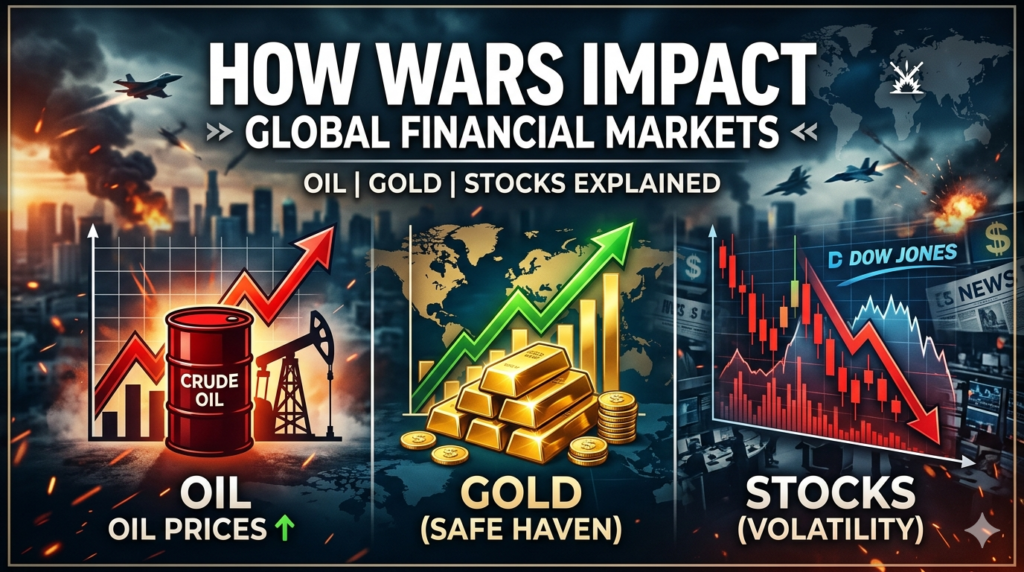
Global wars and geopolitical conflicts are not only political or military events—they are powerful economic shocks that reshape financial markets across the world. When tensions rise between nations, investors, governments, and institutions immediately begin repositioning capital. Oil prices surge, gold demand increases, and stock markets experience waves of volatility.
Understanding how wars influence markets is essential for investors, traders, and financial professionals. Financial history shows that every major conflict—from World War II to the Gulf War and the ongoing Russia–Ukraine War—has triggered dramatic shifts in commodities, currencies, and equity markets.
This article explains why wars affect financial markets, how oil, gold, and stocks react, and what investors can learn from these patterns.
The Economic Chain Reaction of War
Wars create uncertainty, and financial markets react strongly to uncertainty. The global economy operates through complex supply chains, trade routes, and financial systems. When war disrupts any of these systems, markets quickly adjust.
There are several economic channels through which war impacts financial markets.
1. Supply Chain Disruptions
Many wars occur in regions critical to global trade. When transportation routes, shipping lanes, or manufacturing hubs are disrupted, global supply chains slow down.
For example:
- Shipping costs rise
- Raw material supply decreases
- Manufacturing becomes more expensive
This leads to higher inflation, which directly impacts stock markets and interest rates.
2. Energy Supply Shocks
Energy markets are one of the first areas affected by war. Oil and natural gas supply can be disrupted if conflicts occur near key production regions or transportation routes.
One of the most important benchmarks for global oil prices is Brent Crude. When geopolitical tensions rise, traders expect potential supply shortages, pushing oil prices higher.
Higher oil prices have ripple effects:
- Transportation costs increase
- Manufacturing becomes expensive
- Inflation rises globally
For oil-importing countries like India, rising oil prices can weaken currency value and increase inflation.
3. Currency Volatility
Wars often cause investors to move money from riskier assets into stable currencies.
Typically, investors move capital toward:
- US dollar
- Swiss franc
- Japanese yen
This shift creates strong currency fluctuations, affecting international trade and investment.
Why Oil Prices Rise During War
Oil is the most geopolitically sensitive commodity in the world. Many major conflicts occur in regions responsible for large portions of global energy production.
The Middle East, for example, controls a large percentage of global oil supply and hosts critical shipping routes such as the Strait of Hormuz.
When wars threaten these regions, markets fear:
- Supply disruptions
- Sanctions on oil-producing countries
- Blocked shipping routes
As a result, oil traders immediately price in risk, pushing oil prices higher.
For example, during the Gulf War in 1990, global oil prices nearly doubled within months due to fears of supply disruption.
Higher oil prices affect almost every industry:
Industries negatively affected
- Airlines
- Logistics companies
- Manufacturing industries
Industries that benefit
- Oil producers
- Energy companies
- Commodity traders
This dynamic explains why energy stocks often outperform during geopolitical crises.
Gold: The Ultimate Safe-Haven Asset
During war and geopolitical uncertainty, investors search for safe places to store wealth. One of the most trusted assets in times of crisis is Gold.
Gold has served as a store of value for thousands of years, and it tends to perform strongly when markets become unstable.
There are several reasons why gold prices rise during war.
1. Protection Against Currency Devaluation
Wars often force governments to increase spending dramatically, especially on defense and military operations. Governments sometimes finance this spending by increasing debt or printing money.
This can weaken currency value. Investors buy gold to protect purchasing power.
2. Fear and Market Psychology
Markets are not driven purely by economics—they are also driven by psychology. When investors feel uncertain about the future, they prefer assets that have historically held value.
Gold becomes a psychological safe haven during these times.
3. Institutional Portfolio Hedging
Large financial institutions often hedge geopolitical risks by increasing exposure to gold.
Central banks themselves sometimes increase gold reserves during global instability.
Because of this, gold prices often rise during geopolitical crises.
How Stock Markets React to War
Stock markets are extremely sensitive to geopolitical events. The reaction typically follows a three-stage pattern.
Phase 1: Panic
When war begins or geopolitical tensions escalate suddenly, stock markets usually fall sharply. Investors fear uncertainty and sell risk assets.
This phase is driven mainly by fear rather than long-term fundamentals.
Phase 2: Volatility
After the initial panic, markets begin to fluctuate heavily. Investors analyze:
- economic consequences
- government policy responses
- military developments
Some sectors begin to recover while others continue to decline.
Phase 3: Recovery
Once the market understands the scale and duration of the conflict, prices stabilize and recovery begins.
Historically, markets have recovered after most geopolitical crises.
For example, the S&P 500 experienced temporary declines during several major conflicts but eventually resumed long-term growth trends.
Industries That Benefit From War
While war causes widespread economic damage, some industries historically benefit due to increased demand.
Defense Industry
Military conflicts increase government defense spending. Defense contractors receive large government contracts to supply weapons, aircraft, and military equipment.
As a result, defense companies often see rising revenues during geopolitical tensions.
Energy Sector
Energy companies benefit from rising oil prices during conflict.
Oil exploration companies, energy producers, and oil service companies often see increased profits during these periods.
Commodity Producers
War can disrupt mining and agricultural production, pushing commodity prices higher.
Companies involved in producing metals, minerals, and agricultural commodities can benefit from price increases.
Industries That Suffer During War
While some sectors benefit, others face significant challenges.
Airlines and Travel
Airlines are extremely sensitive to fuel prices. When oil prices rise during war, airline operating costs increase dramatically.
At the same time, international travel demand often falls due to safety concerns.
Tourism and Hospitality
Wars reduce tourism activity worldwide. Hotels, resorts, and tourism-related businesses often experience sharp revenue declines during global conflicts.
Consumer Retail
When inflation rises due to higher energy and commodity prices, consumers reduce discretionary spending.
Retail companies often experience declining sales during geopolitical crises.
Historical Examples of War and Market Impact
Financial history provides several clear examples of how wars influence markets.
World War II
During World War II, global economies shifted toward wartime production. Many industries were redirected toward military manufacturing.
Stock markets initially declined due to uncertainty but later recovered as wartime production stimulated economic growth.
Gulf War
The Gulf War caused a major oil price spike due to fears of supply disruption in the Middle East.
However, markets recovered relatively quickly once the conflict ended.
Russia–Ukraine War
The Russia–Ukraine War triggered significant disruptions in global energy and food supply chains.
Key impacts included:
- rising oil prices
- wheat supply shortages
- increased inflation worldwide
These effects highlighted how modern conflicts can affect global financial markets within days.
How Smart Investors Navigate War
While wars create volatility, experienced investors often prepare strategies to manage risk.
Diversification
Investors spread capital across multiple asset classes such as:
- stocks
- commodities
- bonds
- gold
Diversification reduces exposure to sudden market shocks.
Defensive Sectors
Investors often shift portfolios toward industries that are less sensitive to economic cycles.
These include:
- utilities
- healthcare
- consumer staples
These sectors provide stable demand even during economic disruptions.
Commodity Exposure
Because commodity prices often rise during war, some investors increase exposure to commodities such as oil and metals.
This strategy can act as a hedge against inflation and geopolitical risk.
Key Indicators Investors Should Watch During War
To understand how markets may react to geopolitical tensions, investors monitor several important indicators.
Oil prices
Energy prices provide immediate signals about geopolitical risk.
Defense spending
Rising government defense budgets often indicate prolonged conflict.
Interest rates
Central banks may adjust policy in response to inflation triggered by war.
Global trade data
Declining trade activity can signal supply chain disruption.
Monitoring these indicators helps investors understand how war may influence financial markets.
Conclusion
Wars are tragic events with enormous human and economic consequences. However, from a financial perspective, they also reshape global markets in powerful ways.
Energy markets respond quickly to supply risks, pushing oil prices higher. Investors move toward safe-haven assets such as gold, while stock markets experience waves of volatility as uncertainty spreads.
History shows that while markets initially react with fear, they eventually stabilize and adapt to new economic realities.
For investors, understanding the relationship between geopolitics and financial markets is essential. Those who recognize these patterns can better manage risk, protect capital, and identify opportunities during times of global uncertainty.
In an increasingly interconnected world, geopolitical events will continue to influence markets. The ability to interpret these signals is becoming one of the most valuable skills for modern investors.