
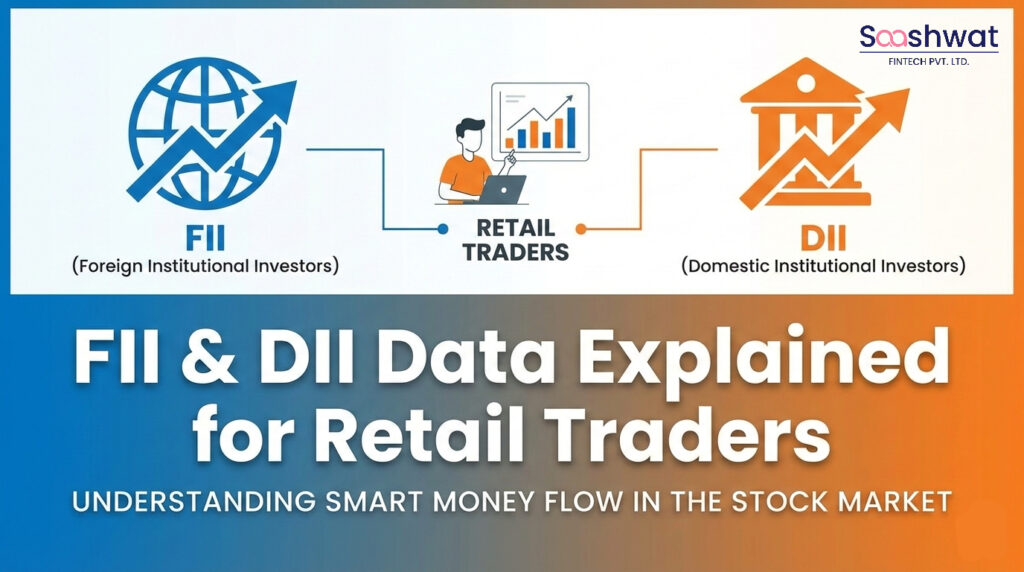
What Is FII (Foreign Institutional Investors)?
Foreign Institutional Investors (FIIs) are large investment institutions based outside India that invest in Indian stock markets. These institutions manage very large amounts of capital, often running into billions of dollars, and therefore their investment decisions can move the market significantly.
FIIs invest in India because of:
- Economic growth opportunities
- Corporate earnings potential
- Currency movement (USD–INR)
- Global risk appetite
Example
If a US-based mutual fund decides to invest ₹10,000 crore in Indian banking stocks, the buying pressure immediately increases prices of stocks like HDFC Bank, ICICI Bank, and Axis Bank. As these stocks have heavy weightage, NIFTY and BANK NIFTY also rise.
Key Points about FIIs:
- Use foreign money
- Trade aggressively
- React quickly to global events
- Strong impact on index movement
What Is DII (Domestic Institutional Investors)?
Domestic Institutional Investors (DIIs) are Indian financial institutions that invest domestic money collected from Indian citizens. Their investment approach is generally more stable and long-term oriented compared to FIIs.
DIIs invest based on:
- Indian economic growth
- Corporate fundamentals
- Long-term valuation comfort
Example
When FIIs sell due to US interest rate hikes, Indian mutual funds may continue buying quality stocks using SIP inflows. This buying helps control market fall and provide stability.
Key Points about DIIs:
- Use Indian money
- Long-term focused
- Support markets during corrections
- Less affected by global panic
Difference Between FII and DII (Conceptual Understanding)
FII and DII are not enemies; they play different roles in the market. FIIs often start trends, while DIIs stabilize them.
Simple comparison:
- FIIs create momentum
- DIIs absorb volatility
- FIIs follow global cycles
- DIIs follow domestic growth
Why FII & DII Data Is Important for Retail Traders
Retail traders usually trade with limited capital and emotional bias. Institutions, on the other hand, trade based on data, planning, and risk management.
Understanding FII & DII data helps retail traders:
- Identify market direction
- Avoid trading against big money
- Reduce unnecessary losses
- Improve trade confidence
Example
If FIIs are continuously selling for 10 days and the market is forming lower highs, buying aggressively is risky. Smart retail traders either reduce position size or stay out.
Where Retail Traders Can Check FII & DII Data
FII & DII data is officially published by stock exchanges.
Sources include:
- NSE daily reports
- BSE daily reports
The data usually shows:
- Total buying value
- Total selling value
- Net buy or sell amount
Important Note:
One-day data is noise. Trend matters more than daily numbers.
How Professionals Interpret FII & DII Data
Professional traders always read FII & DII data along with price behavior.
They focus on:
- Direction of flow (buying or selling)
- Market reaction to that flow
- Support and resistance levels
Example 1: Hidden Strength
FIIs are selling ₹5,000 crore, but NIFTY is not breaking support. This means DIIs or smart money are absorbing supply. Market may move up later.
Example 2: Distribution
FIIs are buying heavily, but NIFTY is not rising. This often indicates big players are selling at higher levels.
Common Mistakes Retail Traders Make with FII & DII Data
Most losses happen due to misunderstanding institutional data.
Common mistakes include:
- Buying just because FIIs bought
- Panic selling when FIIs sell
- Ignoring price structure
- Overtrading without risk limits
Example
A trader buys BANK NIFTY calls after seeing FII buying for one day, but ignores resistance. Market reverses and option premium collapses.
How Retail Traders Should Correctly Use FII & DII Data
FII & DII data should be used as a background filter, not a trigger.
Correct usage framework:
- Use data to understand market bias
- Confirm bias with charts
- Enter trades near support/resistance
- Follow strict stop loss and position sizing
Example
FIIs are net buyers for two weeks, and NIFTY breaks resistance with volume. This is a high-probability setup, not blind buying.
Impact of FII & DII on NIFTY and BANK NIFTY
FIIs have strong influence on banking and financial stocks.
Key impacts:
- BANK NIFTY reacts faster to FII flows
- DIIs reduce volatility in NIFTY
- Sharp index moves often reflect institutional rebalancing
Index traders should always trade in alignment with institutional direction.
Difference in Usage for Traders and Investors
For Traders
- Track short-term FII trends
- Reduce trades during heavy selling
- Focus on risk management
For Long-Term Investors
- Focus on monthly FII/DII trend
- Ignore daily panic
- Accumulate quality stocks during corrections
Saashwat Fintech’s Professional View
At Saashwat Fintech, we teach traders to think beyond news and emotions.
Our philosophy:
- Capital protection first
- Institutional logic over retail excitement
- Data + discipline = consistency
FII & DII data is one piece of the puzzle, not the full picture.
Final Conclusion
FII & DII data explains who controls the market, not where the market will go tomorrow.
Retail traders who:
- Understand institutional behavior
- Combine data with price action
- Follow strict risk rules
are far more likely to survive and grow consistently.
Trade with smart money, not emotions.