
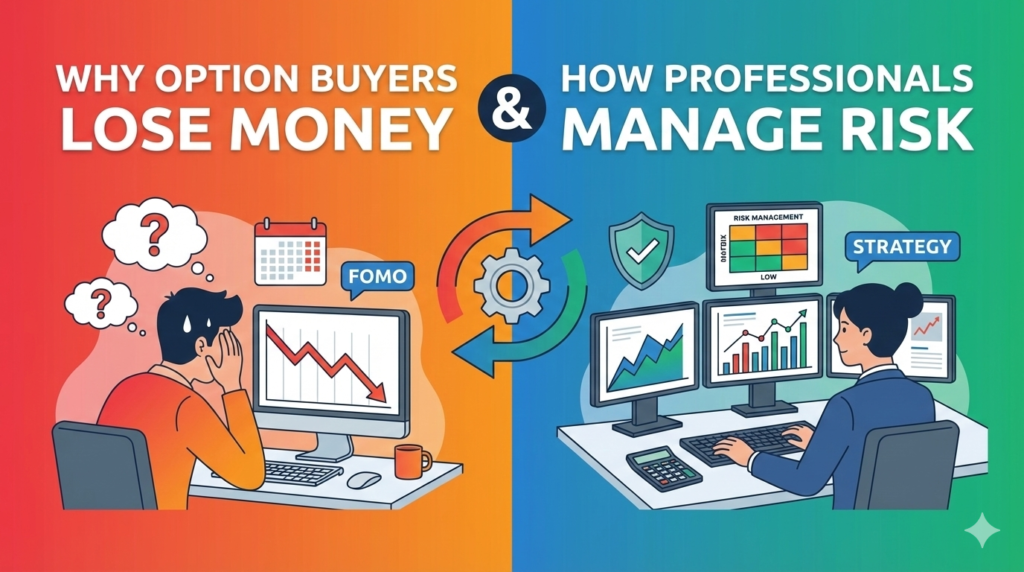
Options trading has become extremely popular in India, especially among retail traders seeking fast profits. Low capital requirements, high leverage, and daily opportunities attract thousands of new participants every month. Yet, data and experience show a harsh truth: most option buyers consistently lose money.
This article explains why option buyers lose, the structural disadvantages they face, and how professional traders manage risk to survive and succeed in the options market.
Understanding Option Buying in Simple Terms
When you buy an option (Call or Put), you are betting on:
- Direction
- Timing
- Speed of price movement
You must be right on all three.
If any one of these fails, the option loses value due to time decay (Theta) or lack of momentum. This makes option buying one of the most difficult forms of trading.
The Main Reasons Option Buyers Lose Money
1. Time Decay Works Against Buyers
Every option loses value as expiry approaches, even if the market does not move. This decay accelerates in the last few days before expiry.
Many traders experience this frustration:
“Market went in my direction, but my option still lost money.”
This happens because Theta decay silently eats premium value.
2. Over-Leverage and Cheap Premium Trap
Options appear “cheap,” encouraging traders to buy large quantities.
Example:
- Capital: ₹50,000
- Option premium: ₹50
- Quantity bought: Very high
A small adverse move can wipe out a large portion of capital.
Low price does not mean low risk.
3. No Defined Stop-Loss
Most option buyers do not use stop-losses or move them emotionally. Losses are often allowed to reach:
- –50%
- –70%
- –100% (full premium loss)
Mathematically, a few full losses destroy months of gains.
4. Poor Understanding of Option Greeks
Retail traders focus only on price movement and ignore:
- Theta (time decay)
- Vega (volatility)
- Delta (price sensitivity)
Professionals trade risk variables, not just direction.
5. Trading Every Day Without an Edge
Options buyers often trade daily without a proven setup, turning trading into probability-negative activity.
High frequency + low edge = guaranteed loss.
Why Option Buying Is Structurally Difficult
Let’s look at probability.
- Most options expire worthless
- Sellers benefit from time decay
- Buyers fight both market movement and time
This does not mean option buying is bad—but it requires exceptional discipline and risk control, which most retail traders lack.
How Professionals Manage Risk in Options Trading
Professional traders approach options very differently.
1. Fixed Risk Per Trade
Professionals never risk the full premium.
They define:
- Maximum loss per trade (usually 0.5%–1% of capital)
- Exit level before entry
Losses are treated as business expenses, not emotional failures.
2. Position Sizing Over Prediction
Instead of asking “Will the market go up?”, professionals ask:
“If I am wrong, how much will I lose?”
They size positions so that no single trade can damage the account.
3. High-Probability Setups Only
Professionals trade options selectively:
- Strong momentum days
- Event-driven volatility
- Clear directional bias
They avoid random, low-conviction trades.
4. Risk-Defined Strategies
Instead of naked option buying, professionals often use:
- Spreads
- Hedged positions
- Limited-risk structures
This keeps drawdowns controlled even during bad market phases.
5. Strict Loss Limits
Professional traders follow:
- Maximum daily loss
- Weekly drawdown limits
- Monthly capital protection rules
When limits are hit, trading stops—no revenge trades.
The Difference Between Retail and Professional Option Traders
| Retail Option Buyer | Professional Trader |
|---|---|
| Trades daily | Trades selectively |
| High quantity | Risk-based sizing |
| No stop-loss | Predefined loss |
| Emotion-driven | Rule-driven |
| Focus on profit | Focus on survival |
Professionals understand one key truth:
You don’t need to win every trade—you need to control every loss.
The Saashwat Fintech Risk-First Approach
At Saashwat Fintech Pvt. Ltd., we teach traders to treat options trading as a risk management business, not a lottery.
Our frameworks focus on:
- Risk-defined option strategies
- Capital-based position sizing
- Stop-loss discipline
- Performance tracking through journals and dashboards
Our goal is to help traders stay in the game long enough to become skilled.
Final Thoughts
Most option buyers lose money not because options are bad, but because risk is ignored. Options magnify both profits and mistakes.
If you want to survive and grow in options trading:
- Accept small losses
- Avoid overtrading
- Focus on risk before reward
Because in options trading, survival is the real edge.
Frequently Asked Questions (FAQ)
1. Is option buying always loss-making?
No, but it requires strict discipline, correct timing, and strong risk management.
2. Why do professional traders prefer selling options?
Because time decay works in their favor, but selling also requires capital and risk control.
3. What is the biggest mistake option buyers make?
Over-leveraging and allowing full premium losses repeatedly.
4. How much capital is ideal for option buying?
Enough capital to risk not more than 1% per trade without emotional stress.
5. Can beginners do options trading?
Yes, but only with education, limited risk, and realistic expectations.